
Biographies > Patrons
Ferdinand II de' Medici
(1610-1670)
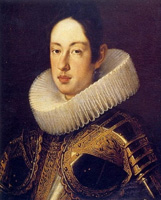
Ferdinand II succeeded his father Cosimo II (1590-1621) in 1621 as Grand Duke of
Tuscany, under the regency of his grandmother, Christina of Lorraine
(1565-1636), and his mother, Maria Maddalena of
Austria. He fostered maritime commerce, developing Leghorn harbor and signing
trade treaties. He consistently supported Galileo (1564-1642) and encouraged
his experimental research. During the 1633 trial, he sought to have the Holy
Office acknowledge Galileo's innocence and allow him to continue his studies.
After Galileo's condemnation, Ferdinand cautiously attempted to have the
decision annulled or mitigated.
In the mid-1640s, the Grand Duke introduced
informal experimentation at his court. Experiments were carried out with the
first-ever thermometers, air humidity was determined with the condensation
hygrometer, and "the heaviness and the lightness of any liquid" was
measured with the hydrometer. In 1644, in the citrus greenhouses of the Boboli
Garden, a type of artificial incubator was tested to hatch chicks. The system
was regulated according to the temperature shown on a 60-degree thermometer
placed under a brooding hen. These experimentation programs laid the groundwork
for the Accademia del Cimento,
founded in 1657 by Ferdinand's brother Leopold (1617-1675).